
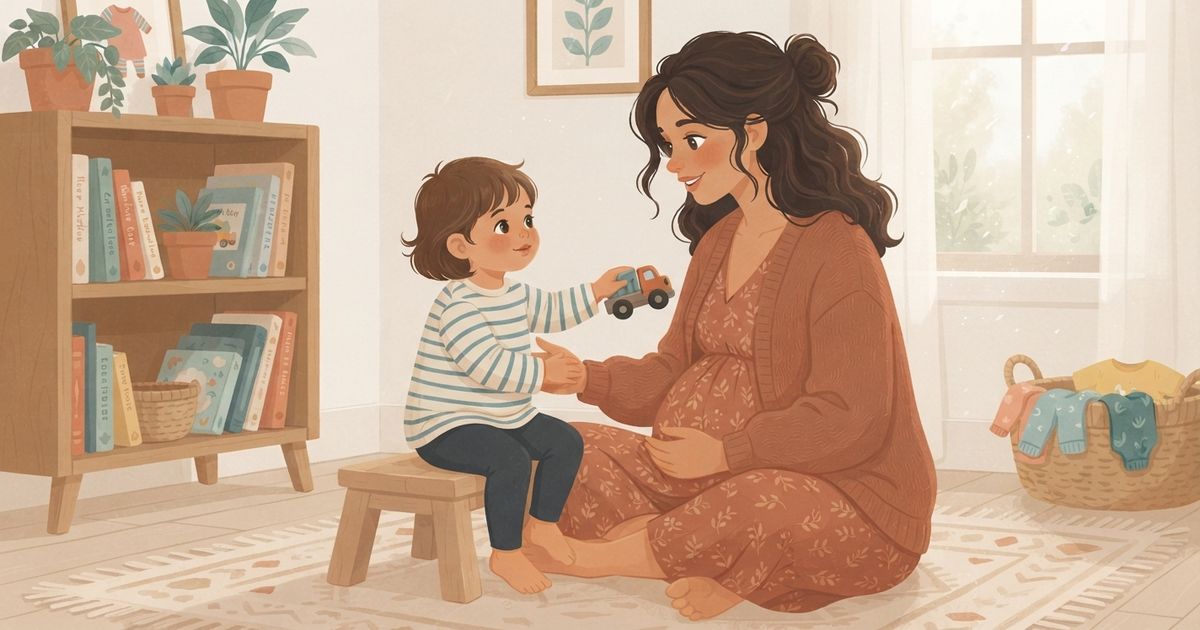
Your two-year-old pats your belly, says "baby," and asks for a snack. Five minutes later she wants to know if the baby can play trucks. You're wondering how much she understands, and how to keep her from feeling replaced.
Here's the short answer. Most toddlers react to a new baby with a mix of curiosity, clinginess and a few bumpy weeks, and then they adapt. What helps most is simple: talk about the baby as a real little person, keep your toddler's routines steady, and protect a bit of one-on-one time every day. The research on how toddlers react to a new baby is more reassuring than most parents expect.
The jealous big sibling is mostly a myth
For a long time, a new sibling was described as a kind of crisis for the firstborn. Psychologist Brenda Volling and her team at the University of Michigan put that idea to the test. They followed 241 families from late pregnancy until the second baby's first birthday.
Their 2017 report found no sign of a lasting developmental crisis. Most children showed few behavior problems and very little change. Some had a burst of aggressive behavior after the birth and then adapted quickly. A smaller group had a harder time.
So what predicted which path a child took? Not a perfect script. It was the child's temperament (their built-in way of reacting to the world), how well the parents worked as a team, how confident the parents felt, and the quality of the parent-child attachment. Attachment, in plain words, is your child's deep sense that "my grown-up is there for me."
One honest caveat: the families came from one region of the US, and much of the information came from parents' own reports. Still, it is one of the largest and most careful studies on this question.
Talk about the baby like a person, not a project
In the early 1980s, psychologists Judy Dunn and Carol Kendrick closely observed a small group of families in England as a second baby arrived. In their book Siblings: Love, Envy, and Understanding (1982), they described how older children whose mothers talked about the baby as a person, with feelings and wants of their own, tended to have friendlier sibling relationships later on. It was a small, decades-old study, but the idea still runs through sibling research today.
What this sounds like at home:
- "I wonder if the baby can hear your voice in there. Want to say hi?"
- "Babies cry because it's the only way they can tell us they're hungry. What do you think the baby will want first?"
Toddlers don't understand months, so connect the date to something they know: "The baby will come when it's cold outside," or "after Grandma's visit."
What toddlers need to hear, and what to skip
Short, true sentences work best, repeated often. The tenth conversation about the baby is not too many.
Be honest about the less exciting parts, too. Newborns cry, sleep a lot and can't play. If you promise a "new best friend," a real baby can be a big letdown. The American Academy of Pediatrics suggests looking at your child's own baby pictures together.
Instead of promising that nothing will change, name what stays the same: "You and I will still have bath and book every night."
Try not to stack other big changes on top. The AAP recommends making changes like a new bed or room well before the baby comes.
Skipped the sibling preparation class? Don't worry. When Volling's team compared children who attended with children who didn't, they found very few differences. What happens at home seems to matter more.
When the big feelings show up anyway
Your toddler may still cling, want a bottle, or ask to be carried like the baby. This is called regression: going back to younger behaviors for a while when life feels big. It is usually a request for closeness, not a step backward. Answer it with connection: "You want me to hold you too. Come here."
All feelings are allowed, including "I don't want the baby." Pushing or hurting the baby is not. You can hold both at once.
And for you: you will not do this perfectly. There will be a rushed evening and a sharper voice. That's human. What helps most is coming back and reconnecting. You and your child are learning this new family shape together.
How a story helps
Toddlers make sense of big changes through repetition and pictures. A story about a child becoming a big sibling lets your toddler see the before, the hospital and the "after" ahead of time, at a safe distance. They can point, ask, and return to the page that worried them. Look for stories that show the mixed feelings too, not only the excitement, so your child knows that whatever they feel has a place.
Try this tonight: start "special time"
Pick 10 minutes a day that belong only to your toddler. No phone, no chores, and your child chooses what to play. Give it a name, like "our time." Start now, so it is already a familiar ritual when everything else changes, and protect it after the birth. On hard days, even five minutes counts.
FAQ
When should I tell my toddler about the new baby? There is no single right week. A common guideline is that the older the child, the earlier you can start. Toddlers struggle with long stretches of time, so many families wait until the pregnancy shows, then link the due date to a season or event.
Is it normal for my toddler to regress after the new baby comes? Yes. Clinginess, sleep changes, potty accidents or baby talk are common and usually short-lived. If the changes are intense or last for several months, talk to your pediatrician.
Should my toddler come to the hospital to meet the baby? If it's possible, the AAP suggests it. Greet your older child first with your arms free, and let them set the pace with the baby.
How do I keep my toddler from feeling replaced? Protect daily one-on-one time, keep familiar routines, and ask visitors to say hello to your older child before the baby.
Sources
- Volling, B. L., Gonzalez, R., Oh, W., et al. (2017). Developmental trajectories of children's adjustment across the transition to siblinghood: Pre-birth predictors and sibling outcomes at one year. Monographs of the Society for Research in Child Development, 82(3). Link.
- Beyers-Carlson, E. E. A., & Volling, B. L. (2017). Efficacy of sibling preparation classes. Journal of Obstetric, Gynecologic & Neonatal Nursing, 46(4), 521-531. Link.
- Dunn, J., & Kendrick, C. (1982). Siblings: Love, Envy, and Understanding. Harvard University Press.
- American Academy of Pediatrics, HealthyChildren.org. Preparing Your Older Child for a New Baby: How to Help Siblings Adjust. Link.
- Nationwide Children's Hospital. Preparing the Family. Link.
Topics in this article
- new baby
- new sibling
- preparing toddler for new baby
- big brother
- big sister
- sibling jealousy
- toddler regression
- attachment
- transition to siblinghood
- Brenda Volling
- Judy Dunn
- positive parenting
QT
Quilloo Team
Bringing together child development research and thoughtful storytelling for parents.
Weekly parenting insights you'll actually use.
No spam. Just thoughtful ideas, expert tips, and stories that make a difference.