Bath time is going fine until your four year old holds up the washcloth and asks, mid scrub, exactly how the baby down the street got into her mommy's belly. No warning, no buildup, just a question dropped into the room like it's the most casual thing in the world. Because to her, it is.
That moment catches almost every parent off guard at least once. The good news is that talking to your kid about bodies does not require a script, a chart, or a single perfect conversation. It works best as a string of small, honest moments that start early and grow with your child.
The First Words Matter More Than the First Big Talk
Long before any conversation about babies, there is an easier and more foundational one: teaching real names for body parts. Penis, vulva, and bottom get the same matter of fact treatment as elbow and knee. No giggling, no code words, no skipping over them during bath time or diaper changes.
This is not about rushing anything. Researchers who study child safety have found that kids who know the correct anatomical terms for their private parts are better equipped to describe their bodies clearly and to speak up if something feels wrong. Dr. Sandy K. Wurtele, a psychologist at the University of Colorado Colorado Springs who developed the widely used Body Safety Training program, has shown through decades of research that this kind of plain, early vocabulary supports both communication and self protection.
Where Do Babies Come From, the Short Version
For a toddler or preschooler, "a baby grows in a special place inside a parent's body called the uterus, and it comes out when it's ready" is a complete and honest answer. It does not lead to more questions, and if it does, that is fine too.
Around age 6 or 7, kids often want a bit more mechanism. "Sometimes a parent carries the baby, sometimes a doctor helps a baby get there in other ways, like adoption or with help from a doctor" opens the door to your own family's story without overexplaining. The goal at every age is to answer exactly what was asked, then stop and see if there is a follow up.
Bodies Belong to the Kid Wearing Them
Somewhere around this same age range, body ownership becomes just as important as body vocabulary. Kids this young can absolutely understand simple rules: their body is theirs, they get to say no to touches they do not like, and there is always a grown up they can tell if something feels confusing or wrong, even if someone asked them to keep it secret.
This part of the conversation tends to feel more natural once the vocabulary piece is already in place. A kid who has heard "vulva" and "penis" said out loud without drama has an easier time reporting anything unusual, because the words already exist for them.
What to Do When the Question Comes at the Worst Time
It always does. In line at Target, at a family dinner, in the school pickup line with three other parents standing right there. A short, honest, age appropriate answer works in the moment: "Great question, let's talk more about it in the car." Then actually follow up later that day. Kids notice when a promised conversation quietly disappears, and it teaches them the topic is off limits, which is the opposite of the message most parents want to send.
How Stories Help Kids Process the Big Questions
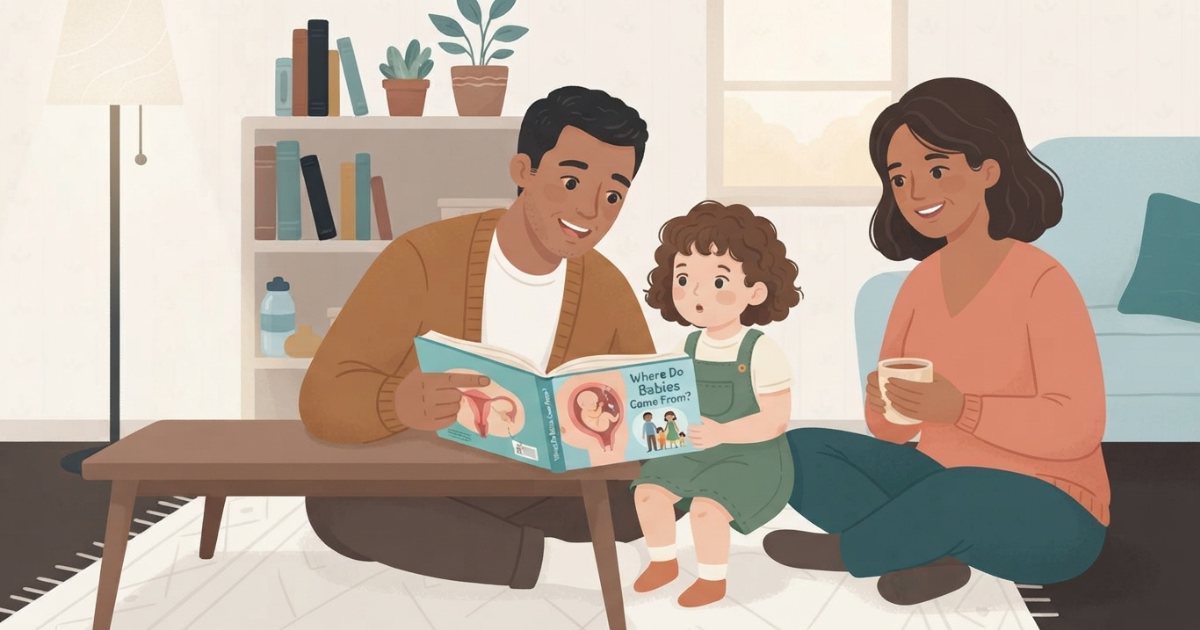
Books give children a low pressure way to sit with big topics without the pressure of a direct one on one conversation. A story lets a child ask questions about a character instead of themselves first, which often feels safer, and it gives the whole family the same shared vocabulary to come back to later. Child development specialists frequently recommend reading together as a starting point specifically because it turns an abstract or awkward subject into something concrete a young child can point at and talk about at their own pace.
Frequently Asked Questions
What age should I start talking to my kid about bodies? As early as toddlerhood. Naming body parts correctly during diaper changes or bath time around age 2 or 3 lays the groundwork for every later conversation, long before any talk about babies or reproduction comes up.
Is it normal for a 4 year old to ask where babies come from? Yes, this is one of the most common questions in the preschool years. A short, honest, age appropriate answer is enough. Kids this age are not looking for a full explanation, just a truthful one.
What if I use the wrong words and my child hears something different at daycare? It happens, and it is not a big deal. Simply say something like "some families use different words, and in our family we say it this way," which teaches flexibility without creating confusion.
How do I know if my child is ready for more detail? Follow their questions. A child who keeps asking is signaling they want more. A child who accepts the short answer and moves on has gotten what they needed for now.
What if I feel too embarrassed to answer? That is common, and kids can usually sense hesitation more than they understand it. It is fine to say "let me think about how to explain that" and circle back within the same day, as long as the follow up actually happens.
Sources
- Wurtele, S. K. Body Safety Training program, developed 1986, revised 2007, Department of Psychology, University of Colorado Colorado Springs.
- Wurtele, S. K., & Owens, J. S. (1997). Teaching personal safety skills to young children: An investigation of age and gender across five studies. Child Abuse & Neglect, 21, 805 to 814.
Topics in this article
- talking to kids about bodies
- where do babies come from
- body safety for kids
- anatomically correct names
- child sexual abuse prevention
- boundaries and consent for kids
- Sandy Wurtele
- preschooler questions
- positive parenting
- personalized book creation
QT
Quilloo Team
Bringing together child development research and thoughtful storytelling for parents.
Weekly parenting insights you'll actually use.
No spam. Just thoughtful ideas, expert tips, and stories that make a difference.