
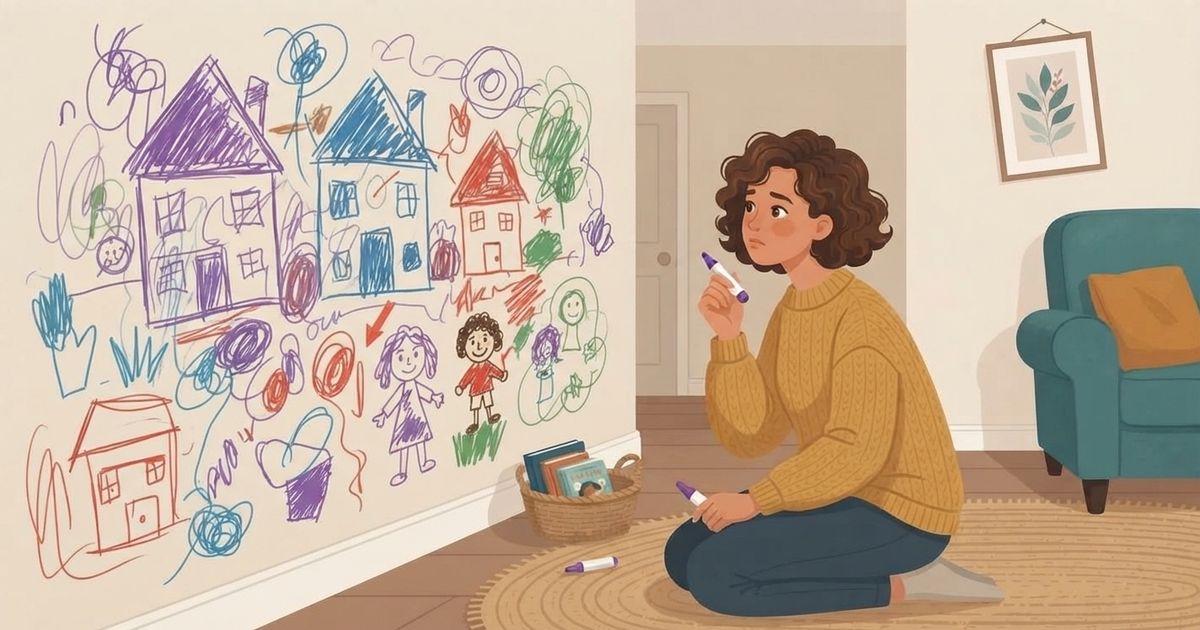
Your six-year-old just drew on the living room wall with a purple marker. Not a small doodle. A full mural. Before you know it, the words are coming out: "What were you thinking? You know better than that. No dessert for a week, and go to your room right now." She stomps off, slams the door, and you're left with a purple wall and a heavy feeling that this didn't really teach anything.
Jane Nelsen, the family therapist behind Positive Discipline, has a question for that exact moment. It's probably the most quoted line she's ever written, and it starts like this: "Where did we ever get the crazy idea..."
The idea, in one sentence
Children don't learn to do better by being made to feel worse. They do better when they feel better.
The full version of Nelsen's question asks where we got the idea that making a child feel worse is the path to making them do better. She has repeated it in talks and articles for decades, and in a 2000 interview she listed it among the core principles of her approach. Once you hear it, it's hard to un-hear, because it names the hidden assumption behind most traditional punishment: that a dose of shame, blame, or pain is what motivates change.
The premise hiding inside punishment
Nelsen's argument isn't that punishment never works. It often works in the short term. The marker gets put down. The behavior stops, at least while you're watching.
Her concern is what happens underneath. In her writing, she points out that when children improve only to avoid a punishment or earn a reward, there's a cost. They may lose some of their internal sense of control, some self-confidence, and the chance to practice the actual life skills involved. The child might stop drawing on walls because you'll be mad, without learning anything about why walls are off-limits, how to fix the mess, or where art can happen instead.
Nelsen also invites adults to run a simple experiment on themselves. Think about the last time you were humiliated or treated unfairly, by a boss, a partner, a stranger at the DMV. In that moment, did you feel a surge of motivation to cooperate and improve? Or did you feel defensive, resentful, maybe a little rebellious? Children aren't wired differently from us on this point.
Where this comes from
The idea grows out of Adlerian psychology, the tradition of Alfred Adler and his student Rudolf Dreikurs, whose ideas Nelsen encountered as a young mother in a college class. A recurring theme in that tradition is that a misbehaving child is a discouraged child. Nelsen connects the two directly: if misbehavior comes from discouragement, then piling on more discouragement through shaming and punishing is like trying to put out a fire with a little more fire.
It follows that when a child feels encouraged, connected, and capable, the motivation for misbehavior shrinks. In her chapter on misbehavior, she puts it even more simply: encouragement doesn't reward misbehavior, it removes the need for it. That's the logic behind almost every tool in Positive Discipline. Nelsen describes the tools as ways to help children feel better so that they're motivated to do better.
It's worth being clear that this is a guiding principle from a clinical and educational framework, built from decades of work with families, rather than the result of one specific experiment. Its strength is how much it changes the question a parent asks in a hard moment.
"Feel better" doesn't mean "no consequences"
This is where many parents push back, and fairly so. Doesn't "help them feel better" just mean letting things slide?
Not in Nelsen's approach. Feeling better isn't about making the problem disappear or rescuing the child from responsibility. It's about creating the emotional conditions in which a child can actually think, learn, and take responsibility. A child who is drowning in shame is busy defending themselves. A child who feels safe enough can look at what happened and help fix it.
So the purple wall still gets addressed. The difference is how.
Two versions of the same evening
Here's the purple mural, run twice.
Version one: shouting, a week without dessert, the bedroom door slammed. The wall gets scrubbed later by a parent who's still annoyed. The child learns that markers make grownups angry and that she's "bad." The next time she makes a mistake, she might be more tempted to hide it.
Version two: the parent takes a breath (and maybe a few minutes) first. Then: "Whoa. That's a lot of purple. Walls aren't for drawing, and I can see you really wanted to make something big. Let's get a sponge and clean it together. Then let's figure out where big art can go." The child scrubs alongside the parent. Maybe a roll of butcher paper gets taped to the floor afterward.
In version two, there's still accountability. The child helps repair the damage. But she walks away with dignity intact and a better plan for next time.
Before you respond, try this
The next time you feel the urge to make a point by making your child feel bad, try this simple sequence.
Pause and check your goal. Ask yourself: do I want my child to suffer for this, or do I want them to learn from it? Those lead to very different responses.
Calm down before you correct. If you're too upset to speak kindly, it's okay to say, "I'm too frustrated to talk about this right now. We'll figure it out in a few minutes." That's modeling, not avoidance.
Separate the child from the behavior. Talk about what happened ("The marker went on the wall") rather than who they are ("You're so careless").
Invite them into the repair. Ask, "What can we do to fix this?" Children are often surprisingly creative and willing when they're not on the defensive.
Look ahead, not just back. End with a plan for next time. "Where can you draw when you want to make something really big?"
You'll probably still feel the old reflex for a while. That's normal. Every time you choose the second version, you're teaching a lesson far more durable than "don't get caught."
Frequently Asked Questions
Does punishment work for young children?
Punishment can stop a behavior in the short term, but Jane Nelsen argues it often teaches avoidance rather than skills. Children may stop to avoid getting in trouble without learning what to do instead.
What does "children do better when they feel better" mean?
It's a core idea in Positive Discipline. Children who feel encouraged and connected are more able and more motivated to cooperate and learn, while shame and humiliation tend to trigger defensiveness.
Is positive discipline the same as having no consequences?
No. Positive Discipline still holds children accountable, but focuses on repair and solutions rather than suffering. A child might help clean up a mess instead of losing dessert for a week.
What should I say instead of punishing?
Name what happened without labeling the child, invite them to help fix it, and make a plan for next time. For example: "The marker went on the wall. Let's clean it together, then find a place for big art."
Sources
- Jane Nelsen, Positive Discipline: The Classic Guide to Helping Children Develop Self-Discipline, Responsibility, Cooperation, and Problem-Solving Skills (Ballantine Books, revised 2006 edition), Chapter Four, "A New Look at Misbehavior."
- Jane Nelsen, "A Misbehaving Child is a Discouraged Child," PositiveDiscipline.com. Link.
- Tara Katir, interview with Jane Nelsen, "Better Discipline," Hinduism Today, November/December 2000. Link.
Topics in this article
- does punishment work
- Jane Nelsen
- Positive Discipline
- alternatives to punishment
- shame and discipline
- encouragement
- discouraged child
- Adlerian parenting
- accountability for kids
- preschooler discipline
- school-age behavior
QT
Quilloo Team
Bringing together child development research and thoughtful storytelling for parents.
Weekly parenting insights you'll actually use.
No spam. Just thoughtful ideas, expert tips, and stories that make a difference.