
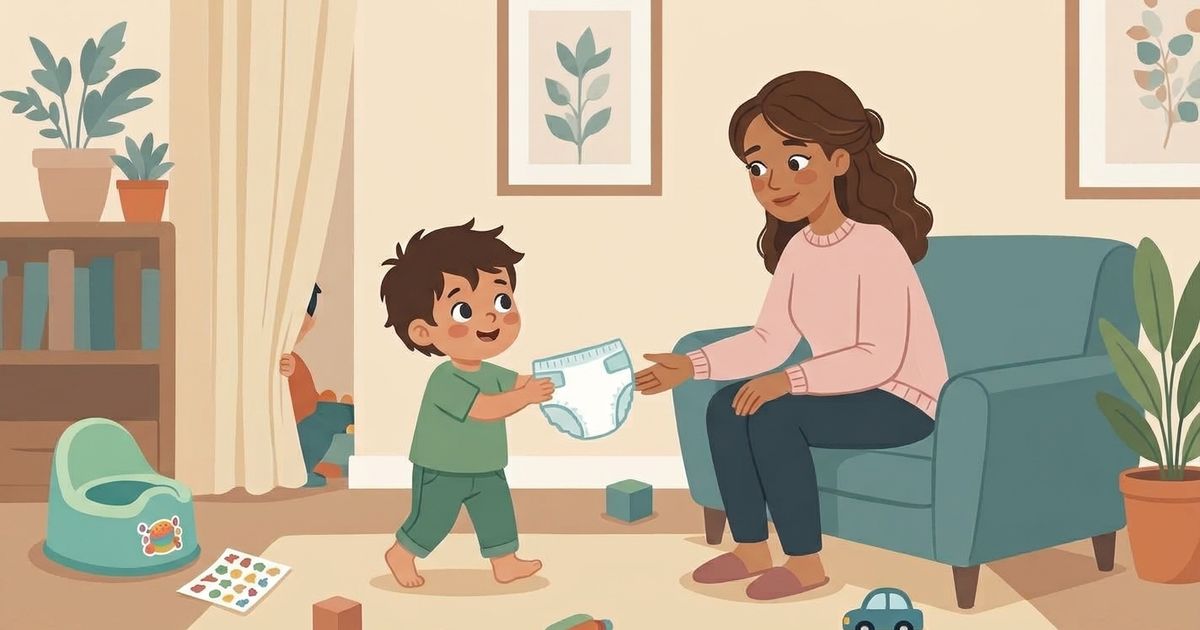
He pees in the potty like a champion, collects his sticker, does a little victory dance. Then, twenty minutes later, he walks up holding a diaper and asks, very politely, for his "poop diaper." Off he goes to his favorite spot behind the curtain.
If your toddler will only poop in a diaper, it is normal and very common. Doctors call it stool toileting refusal: a child who uses the potty for pee but insists on a diaper for poop. In a trial of about 400 toddlers led by pediatrician Bruce Taubman, roughly 1 in 4 went through it during potty training. It is usually a phase, not defiance, and it tends to ease when the pressure comes off, poop stays soft, and the child moves toward the toilet in small steps.
Pooping is a bigger deal than peeing
Pee is quick. Poop takes longer, needs relaxed muscles, and to a small child can feel like losing a piece of their own body into a loud, splashing hole. A 2019 review in American Family Physician lists the usual reasons behind the refusal: pain from constipation, skin irritation, fear of the toilet or the flush, and changes in routine or family life. The diaper, by contrast, is familiar. Many toddlers have pooped standing up, in the same cozy corner, their whole lives.
Control plays a part too. Toddlers are discovering that some things are theirs to decide, and their body tops the list. Pushing usually makes a child hold on harder.
The real thing to watch is not the diaper. It's withholding, which means holding poop in to avoid going. Held stool gets harder, the next poop hurts, and the fear grows. That's why the pediatric advice is so consistent on one point: a poop in a diaper is far better than a poop held in.
What different approaches suggest (and where they agree)
The child-oriented approach follows the child's readiness signs with no pressure. Taubman's team tested one addition to it: parents praised poops in the diaper and avoided negative words like "yucky" or "stinky." The refusal still happened just as often, but it lasted about 5 months instead of 7.5, and those kids finished training roughly 3 months sooner. The families came from one suburban practice, mostly white and middle class, so it's a solid hint rather than the final word.
Pediatric guidance written for parents by pediatrician Barton Schmitt, MD, FAAP, says: hand over the diaper when asked, stop the reminders, never force a child to sit, and work with your doctor to keep stools soft.
Behavioral approaches break the goal into tiny steps. A 1999 American Family Physician guide by Brett Kuhn, PhD, and colleagues suggests short, pleasant potty sits, rewards for poop in the toilet (not for clean pants, which can encourage holding), and a clear "graduation" from diapers once the child is ready.
Montessori and attachment-based approaches lean on the same values: the child's own pace, independence and a relaxed connection with the parent.
They disagree on one detail. Some behavioral guides warn that offering a diaper now and then sends mixed messages, while Schmitt and UK bowel charity ERIC say never to refuse the diaper for a poop. Where they all agree: no shame, no punishment, no forcing, and soft poop first.
Small steps from the diaper to the toilet
ERIC describes moving the child's "poop spot" toward the toilet a little at a time. You might try:
- Keep poop soft. Water, fruits and vegetables, and a conversation with your pediatrician about whether a stool softener makes sense.
- Move the diaper poop into the bathroom. Same diaper, new room.
- Sit on the potty with the diaper on. Feet on a stool, a book in hand.
- Loosen the diaper while sitting, then let it rest inside the potty or toilet, until only a bit of toilet paper is left.
- Tip the poop from the diaper into the toilet together and wave goodbye. If the flush is scary, let your child flush from the doorway.
Add 5-minute sits after meals, when the body is most ready to go. Celebrate tries, not results, and if your child gets upset, go back a step.
When to call your pediatrician
Call if:
- Poop is hard or painful, or you think your child is blocked up.
- Constipation lasts more than two weeks or doesn't improve with home care.
- You see stool in the underwear that looks like diarrhea. It can be leakage around hard, stuck poop.
- Your child goes several days without pooping. Kuhn's guide suggests agreeing on a plan with your doctor, such as calling after four days.
- The refusal is still going strong after several months, or your child is 4 or older. A doctor can rule out rarer physical causes and refer you to a pediatric gastroenterologist or a child psychologist if fear is the main block.
Get care right away for blood in the stool, ongoing belly pain, bloating, vomiting or weight loss.
How a story helps
Fear of the toilet is hard to argue away, because to a toddler it feels completely real. A story about a character who is nervous about pooping on the potty lets a child watch that fear from a safe distance and see it ease. It also gives you shared words ("the poop wants to go home to the toilet") that turn a tense moment into a familiar ritual. Reading it during a relaxed potty sit makes the bathroom a cozier place to be.
FAQ
Is it normal for a toddler to pee in the potty but poop in a diaper? Yes. Doctors call it stool toileting refusal, and in one trial of about 400 toddlers roughly 1 in 4 went through it. Most children grow out of it with patience and soft stools.
Should I give my child a diaper to poop in? Many pediatric guides say yes, because pooping in a diaper is much better than holding it in. Offer it calmly, keep it near the bathroom, and work toward the toilet in small steps.
How long does poop refusal last? In Taubman's study it lasted about 5 to 7.5 months on average. It was shorter when parents praised poops in the diaper and avoided negative words about poop.
Why is my child scared to poop on the potty? Common reasons are a past painful poop, fear of the toilet or the flush, and the strange feeling of sitting instead of standing. Changes at home or daycare can add to it.
When should I worry about my child refusing to poop on the potty? Call your pediatrician if poop is hard or painful, constipation lasts more than two weeks, stool leaks into the underwear, or the refusal goes on for months. Get care right away for blood in the stool, vomiting or ongoing belly pain.
Sources
- Taubman, B., Blum, N. J., & Nemeth, N. (2003). Stool toileting refusal: A prospective intervention targeting parental behavior. Archives of Pediatrics & Adolescent Medicine, 157(12), 1193-1196. Link
- Baird, D. C., Bybel, M., & Kowalski, A. W. (2019). Toilet training: Common questions and answers. American Family Physician, 100(8), 468-474. Link
- Kuhn, B. R., Marcus, B. A., & Pitner, S. L. (1999). Treatment guidelines for primary nonretentive encopresis and stool toileting refusal. American Family Physician, 59(8), 2171-2178. Link
- Schmitt, B. D. Toilet training resistance: Constipation from stool holding. Pediatric Care Advice (AAP-licensed content), via Children's Primary Care Medical Group. Link
- ERIC, The Children's Bowel & Bladder Charity. Children who will only poo in a nappy and other toilet avoiders. Link
- National Institute of Diabetes and Digestive and Kidney Diseases. Symptoms & causes of constipation in children. Link
Topics in this article
- stool toileting refusal
- toddler will only poop in diaper
- poop on the potty
- potty training poop
- stool withholding
- toddler constipation
- toilet training resistance
- fear of the toilet
QT
Quilloo Team
Bringing together child development research and thoughtful storytelling for parents.
Weekly parenting insights you'll actually use.
No spam. Just thoughtful ideas, expert tips, and stories that make a difference.