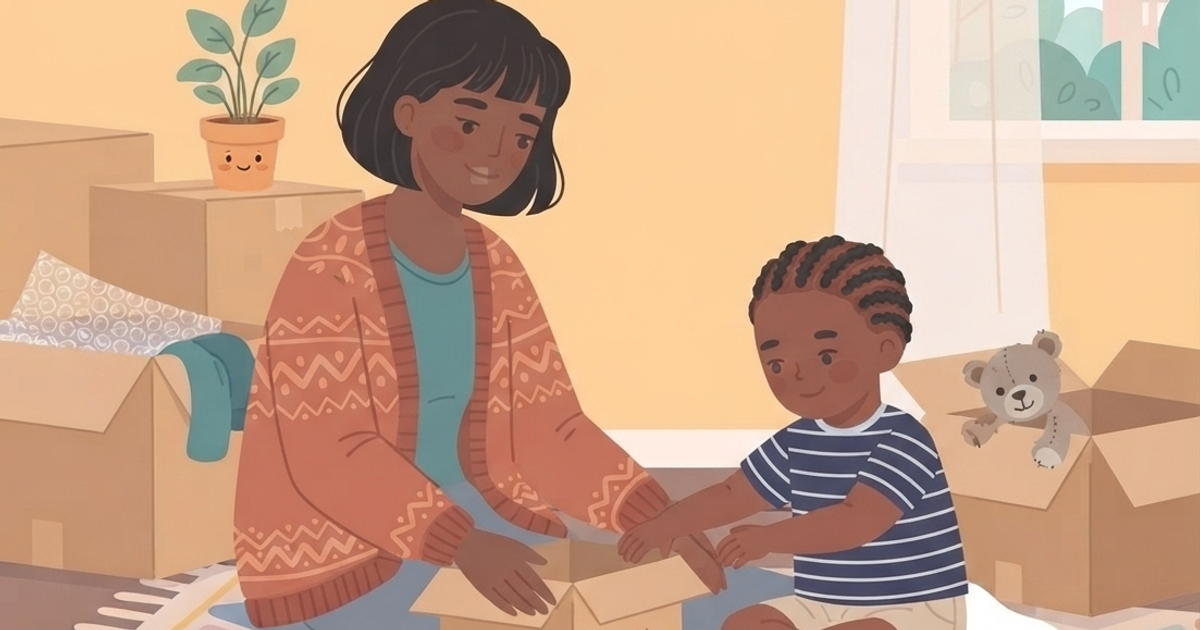
Boxes everywhere, a kid asking for the fortieth time where their bed is going, and somewhere in the chaos you start wondering if you've just permanently traumatized your entire family for a slightly bigger kitchen. Good news. There's a real, research-backed shape to how this settles, and it's shorter than the panic makes it feel.
The rule that tells you exactly how long to white-knuckle it
Child psychologist and relocation specialist Lori Collins Burgan developed what's become known as the 3-3-3 rule for family moves: 3 days of pure disruption, 3 weeks of settling in, and 3 months to feel genuinely adjusted. Knowing this shape in advance changes the experience, because a rough week two isn't a sign that something's gone wrong, it's just where you're supposed to be on the timeline.
The move itself isn't actually the risky part
Here's a detail that surprises a lot of parents bracing for the worst. Research published in Social Science Research found that a moderate move paired with upward mobility, a genuinely better situation for the family, was actually associated with kids developing a stronger internal sense of control, not a weaker one. The moves that tend to cause real, lasting difficulty are usually stacked with other instability, like family separation happening at the same time, not the relocation on its own.
Say goodbye before you say hello
Child psychologist Doug Ota has written extensively about a principle that sounds almost too simple to matter, say proper goodbyes before rushing into new hellos. Kids form real attachments to places, not just people, the specific tree in the old backyard, the walk to the corner store, the room they've always slept in. Skipping the goodbye process because everyone's busy packing can leave those attachments dangling, unresolved, in a way that quietly complicates the settling-in period later.
The boring stuff is doing more work than you'd think
Across pretty much all the research on this, one theme keeps showing up. Keeping small routines intact through the chaos, the same bedtime story, the same Saturday pancakes, even eating dinner together sitting on boxes, gives kids something stable to hold onto while literally everything else around them is in flux. It's not glamorous advice. It also happens to be one of the most consistently supported findings in the research.
A story lets a kid rehearse the "hello" part in advance
Since so much of what makes a move hard is the unknown of the new place, a story where a character moves somewhere new, feels weird about it at first, and ends up finding their footing, gives a child a preview of that arc before they're living it in real time. It won't replace an actual goodbye ritual for the old house, but it can make the new one feel a little less like a total blank page.
Frequently Asked Questions
How long should I expect my child to need to adjust after a move? The commonly cited 3-3-3 framework suggests roughly 3 days of disruption, 3 weeks of settling, and 3 months to feel fully adjusted, though this varies by child.
Does moving always negatively affect kids? Not necessarily. Research suggests moves paired with genuine improvement in circumstances can be associated with positive outcomes, not just stress.
Should we say goodbye to our old house before moving? Many child psychologists recommend it. Kids attach to places, not just people, and skipping this step can leave that attachment unresolved.
What helps most during the actual chaos of moving? Keeping small routines consistent, bedtime rituals, regular meals, familiar objects unpacked first, tends to matter more than most people expect.
Sources:
- Burgan, L. C. The "3-3-3 rule" framework for family relocation adjustment, child psychology and relocation specialist.
- Ota, D. Writing on transitions in international and family relocation, emphasizing "goodbyes before hellos."
- Valente, R., & Vidal, T. (2026). Study on moderate residential moves, upward mobility, and children's locus of control. Social Science Research.
Topics in this article
- positive parenting
- personalized stories
- child psychology
- family transitions
- resilience
QT
Quilloo Team
Bringing together child development research and thoughtful storytelling for parents.
Weekly parenting insights you'll actually use.
No spam. Just thoughtful ideas, expert tips, and stories that make a difference.