
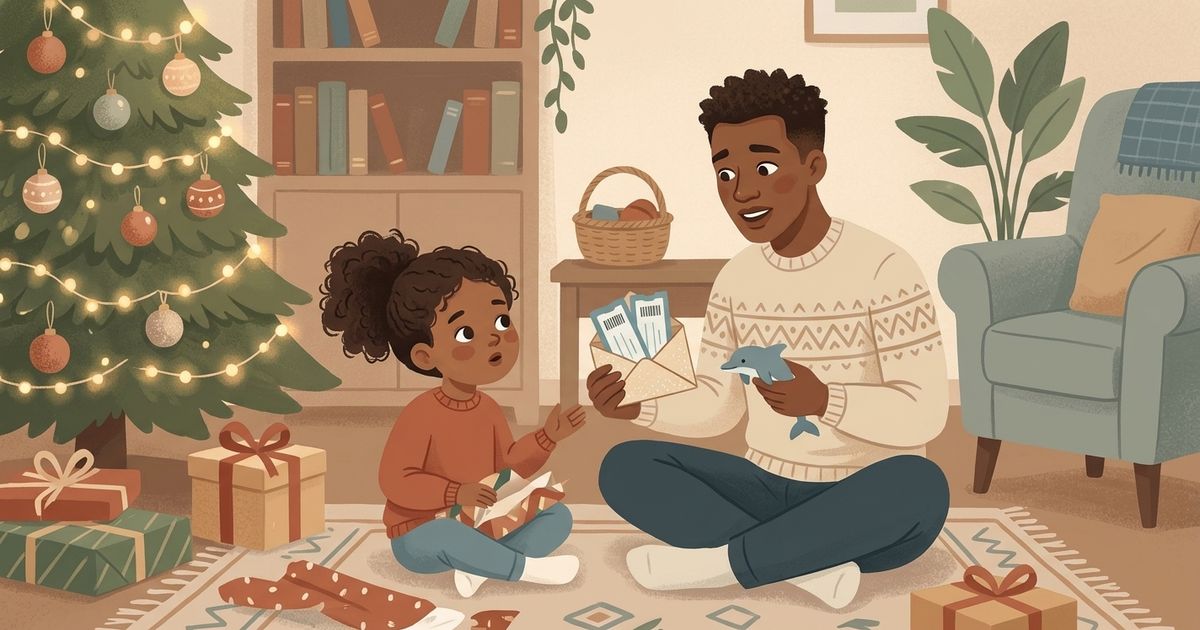
You wrap a beautiful envelope: two tickets to the aquarium, just you and her. Your 4-year-old opens it, looks at the paper, looks at you, and asks, very politely, where the actual present is.
Are experience gifts for kids better than toys? For adults, research says experiences often bring more lasting happiness and closer relationships. For young children, it's more complicated: kids under about 12 tend to get more happiness from things they can hold. Experience gifts still matter a lot for little ones, but they work best when you make the experience something a child can see, touch and remember.
What the research says, for grown-ups and for kids
In a 2017 paper in the Journal of Consumer Research, Cindy Chan of the University of Toronto and Cassie Mogilner of UCLA ran four studies and found that experiential gifts, like a concert or a cooking class, strengthened the relationship between giver and receiver more than material gifts did. The reason seemed to be emotion: experiences tend to be felt more intensely. These studies were with adults.
Children are a different story. In a 2020 study in the International Journal of Research in Marketing, a team led by Lan Nguyen Chaplin asked children and teens ages 3 to 17 what made them happy. Children ages 3 to 12 got more happiness from material goods than from experiences. Older teens showed the adult pattern and preferred experiences. The researchers connected the shift to two developing skills: memory, and theory of mind, which is the ability to understand what others think and feel.
Put simply, a toy is still there tomorrow. A trip to the zoo is over by dinner, and a 4-year-old doesn't yet have the memory skills to keep enjoying it. "For experiences to provide enduring happiness, children must be able to recall details of the event," Chaplin said.
How to make experience gifts work for young kids
The good news is that you can help an experience stick. A few things that help:
- Make it unwrappable. Pair the experience with a small object: a toy dolphin for the aquarium trip, a tiny ballet slipper keychain for the dance show, a ticket in a box with ribbon.
- Build anticipation. Mark the day on a calendar your child can see and count down. Looking forward is part of the gift.
- Take photos and retell it. Chaplin suggests photographing or filming outings so children have reminders to revisit. Afterward, talk it through: "Remember when the sea lion splashed us?"
- Make a little book of the day. A few printed photos and your child's own words turn one afternoon into a story they can return to.
- Do it together. For young children, the best part of most experiences is a grown-up's full attention.
Experience gift ideas by age
Ages 1 to 3
- A family membership to a children's museum, zoo or botanical garden
- Toddler swim or music classes
- A trip to a farm, an apple orchard or a pumpkin patch in season
- A "train day" riding a local train or bus just for fun
Ages 4 to 5
- Tickets to a children's theater or puppet show
- A pottery-painting session or a kids' cooking class
- A special one-on-one "date" with a parent or grandparent, planned together
- A camping night in the backyard, or in a living-room tent
Ages 6 to 8
- Lessons in something they've asked about: climbing, art, an instrument, swimming
- A day trip planned with them, using a map
- A sports game, an ice rink session, or a science center visit
- A "skill weekend": learning to bake bread, ride a bike without training wheels, or build a birdhouse
When a toy really is the better choice
It's okay to give both. If your child has their heart set on a particular toy, that toy is a sign they feel heard. A mix often works best: one wished-for toy to open on the morning, and an experience gift that brings you together later in the season. For younger kids especially, the toy and the outing don't compete. They complete each other.
One honest note: experience gifts don't have to be expensive. A library card, a picnic in the park, or a night of flashlight reading under a blanket fort can be just as exciting to a 5-year-old as a theme park.
How a story helps
A story can be the bridge between an experience and a memory. When you read a book about a visit to the zoo before going, a child knows what to expect and feels more confident. After the trip, a story about their day, with their name and their favorite animal in it, helps them hold on to the experience. Reading it again weeks later brings the feeling back, which is exactly what young children's memories need.
One easy way to do this is to turn the experience itself into a small personalized book, with your child as the hero of "The Day We Went to the Aquarium." It gives a young child something to unwrap and hold, and a way to relive the day long after it's over.
FAQ
Are experience gifts good for toddlers? Yes, especially when paired with something to hold and photos to revisit. Toddlers won't remember the details for long, but the shared time and the feeling of being together still matter.
Do kids prefer toys or experiences? Research suggests children ages 3 to 12 get more happiness from material goods, while teens prefer experiences. The shift seems linked to developing memory and social understanding.
How do you wrap an experience gift for a child? Put a ticket or a small related object in a box, like a toy animal for a zoo trip or a paintbrush for an art class, so there's something to open on the day.
What are cheap experience gifts for kids? A library card, a picnic, a backyard campout, a baking day together or a free museum day are all low-cost experience gifts children love.
Sources
- Chan, C., & Mogilner, C. (2017). Experiential gifts foster stronger social relationships than material gifts. Journal of Consumer Research, 43(6), 913-931. EurekAlert news release. Link
- Chaplin, L. N., Lowrey, T. M., Ruvio, A. A., Shrum, L. J., & Vohs, K. D. (2020). Age differences in children's happiness from material goods and experiences: The role of memory and theory of mind. International Journal of Research in Marketing, 37(3), 572-586. Link
- University of Illinois Chicago (2020). Why experiences are better gifts for older children. Link
Topics in this article
- experience gifts for kids
- experiences vs toys
- non-toy gifts
- children's happiness research
- Lan Nguyen Chaplin
- gifts of time
- family outings
- memory in young children
QT
Quilloo Team
Bringing together child development research and thoughtful storytelling for parents.
Weekly parenting insights you'll actually use.
No spam. Just thoughtful ideas, expert tips, and stories that make a difference.