
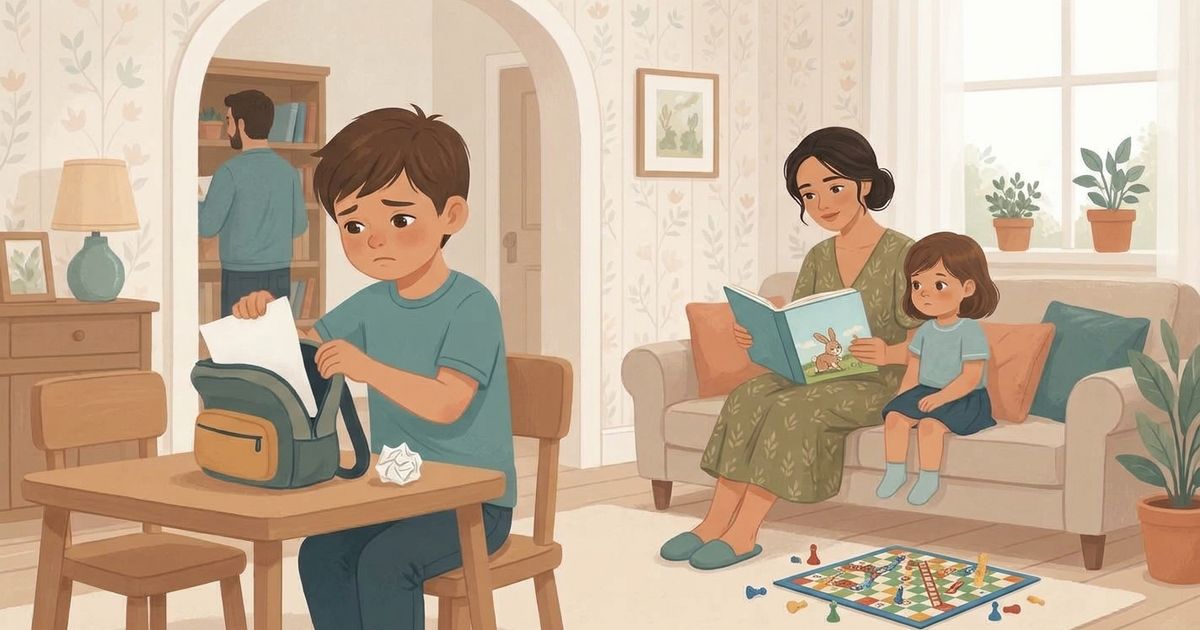
The game of Chutes and Ladders was going beautifully until your 4-year-old slid down the longest chute on the board. Pieces flew, the board flipped, and someone announced through tears that this is the worst game ever invented. A few years later, the same child walks out of school, shoves a spelling test with a 6 out of 10 to the bottom of the backpack, and goes very quiet.
Big reactions to losing a game or getting a low grade are normal at every age. They just change shape as kids grow. Little kids mostly feel the sting of not getting what they wanted, while school-age kids start to wonder what a loss says about them. The way to help a child cope with losing is surprisingly similar at every age: stay calm, name the feeling, and treat the setback as information about what to try next, not a verdict on who your child is.
Losing feels different at 2, 5 and 8
Toddlers (1 to 3). Competition barely exists yet. A toddler who wails when a sibling "wins" is usually upset about the moment itself: the turn ended, the toy went away. The brain's brakes for big feelings are still under construction. What helps most is co-regulation, which means your calm nervous system helps settle theirs. Short, cooperative games work better than games with a winner.
Preschoolers (3 to 5). Now kids know exactly what winning is, and they want it badly. Many cheat, change the rules mid-game or quit when they fall behind. One reason: young children are wildly optimistic about their own abilities. In a 2022 study in Child Development, 4- and 5-year-olds in China and the Netherlands predicted they would do about twice as well as they actually did on a throwing task, and they kept overestimating even after seeing their results. The researchers note this optimism may actually help kids try new things. It also makes losing feel enormous.
Early school age (5 to 7). Rules start to matter, and so do reading levels, sticker charts and the first real grades. Kids this age already notice how they compare with others. In a classic 1998 study of 840 children ages 4 to 8, psychologist Ruth Butler found that even 4- and 5-year-olds rated themselves lower after doing worse than another child, and doing worse than a peer lowered motivation at every age. Comparing themselves with their own past performance came later, so "You did better than last week" may need concrete proof for a 5-year-old ("Last week you read three pages, today you read five").
Older kids (7 to 8 and up). Expectations start doing heavy lifting. In a 2021 lab study in Developmental Psychology, children played a rigged prize game. Kids 6 and older who had just lost, and expected little, liked the small consolation prize more than kids who had expected a big win. For 4- and 5-year-olds, expectations made no difference. It was a single lab study of about 200 people, so treat it as a hint, but it fits what many parents see: by early grade school, "I thought I'd get a 10" can hurt more than the 6 itself. This is also the age when a low grade can start to feel like proof of being "bad at math."
What your reaction teaches
Children read our faces after a setback more closely than our words. In a 2016 study in Psychological Science, Stanford researchers Kyla Haimovitz and Carol Dweck surveyed 73 parent-child pairs. Parents who saw failure as harmful had children who were more likely to believe intelligence is fixed. In follow-up online studies, those parents reacted to a hypothetical failing grade with worry about their child's ability and offered less help with learning.
Two caveats: the children were 4th and 5th graders, and the study shows a link, not proof of cause. Still, these habits start early. The message we want a child to absorb is simple: mistakes are how learning happens.
What to say after a loss or a low grade
- Feelings first. "You really wanted to win. Losing feels terrible." Skip "It's just a game" for now. To them, it isn't.
- Hold the limit kindly. "You can be mad. Throwing the pieces is not okay. Let's take a breath together."
- Get curious, not critical. Ask what went well and what they wish had gone differently, then offer to practice. For a test: "Which part felt tricky? Want to look at it together?"
- Show them how you lose. "Aw, I lost. That's disappointing. Good game, though."
- Mix in cooperative games. Games where everyone wins or loses together let young kids practice the fun of playing before the pain of losing.
- Repair if you lost your cool. If you sighed at the test or snapped at the flipped board, come back later and reconnect.
If your child's reactions are intense, last a long time or happen daily, if they avoid every challenge, or often call themselves stupid, talk to your pediatrician or your child's teacher. A low grade that keeps repeating can also point to a learning difference worth checking.
How a story helps
Stories let children watch a character lose, feel awful and try again, all from the safety of a parent's lap. A story about a character who loses a race, stomps off, and later decides to practice gives your child a script for their own next loss. Afterward you can ask, "What helped the bunny feel better?" and you are talking about coping without a lecture.
FAQ
Is it normal for a 4-year-old to cheat at games? Yes. Preschoolers are still learning that rules apply to everyone, and losing feels huge to them. Gently restate the rule and keep playing, rather than treating it as a moral failing.
Should I let my child win at board games? Sometimes, especially with toddlers and young preschoolers, and cooperative games help too. As kids grow, winning and losing for real gives them safe practice with disappointment.
At what age do kids learn to lose gracefully? It develops slowly through the early school years and keeps improving with practice. Many 7- and 8-year-olds still struggle, especially when they are tired or expected to win.
What should I say when my child gets a bad grade? Start with their feelings, then get curious about what was hard and make a small plan together. Treat the grade as information about what to practice, not a judgment of how smart they are.
Sources
- Xia, M., Poorthuis, A. M. G., Zhou, Q., & Thomaes, S. (2022). Young children's overestimation of performance: A cross-cultural comparison. Child Development, 93(2), e207-e221. Link
- Butler, R. (1998). Age trends in the use of social and temporal comparison for self-evaluation: Examination of a novel developmental hypothesis. Child Development, 69(4), 1054-1073. Link
- Lara, K. H., Kramer, H. J., & Lagattuta, K. H. (2021). This is not what I expected: The impact of prior expectations on children's and adults' preferences and emotions. Developmental Psychology, 57(5), 702-717. Link
- Haimovitz, K., & Dweck, C. S. (2016). What predicts children's fixed and growth intelligence mind-sets? Not their parents' views of intelligence but their parents' views of failure. Psychological Science. Summary from ScienceDaily. Link
- KidsHealth from Nemours. Sportsmanship (medically reviewed by Margaux J. Barnes, PhD, October 2023). Link
Topics in this article
- child can't handle losing
- sore loser kids
- bad grades
- coping with failure
- kids cheating at games
- competitive games for kids
- failure mindset
- Carol Dweck
QT
Quilloo Team
Bringing together child development research and thoughtful storytelling for parents.
Weekly parenting insights you'll actually use.
No spam. Just thoughtful ideas, expert tips, and stories that make a difference.